
Looking For a Lifeboat
Greed and Gullibility No 45

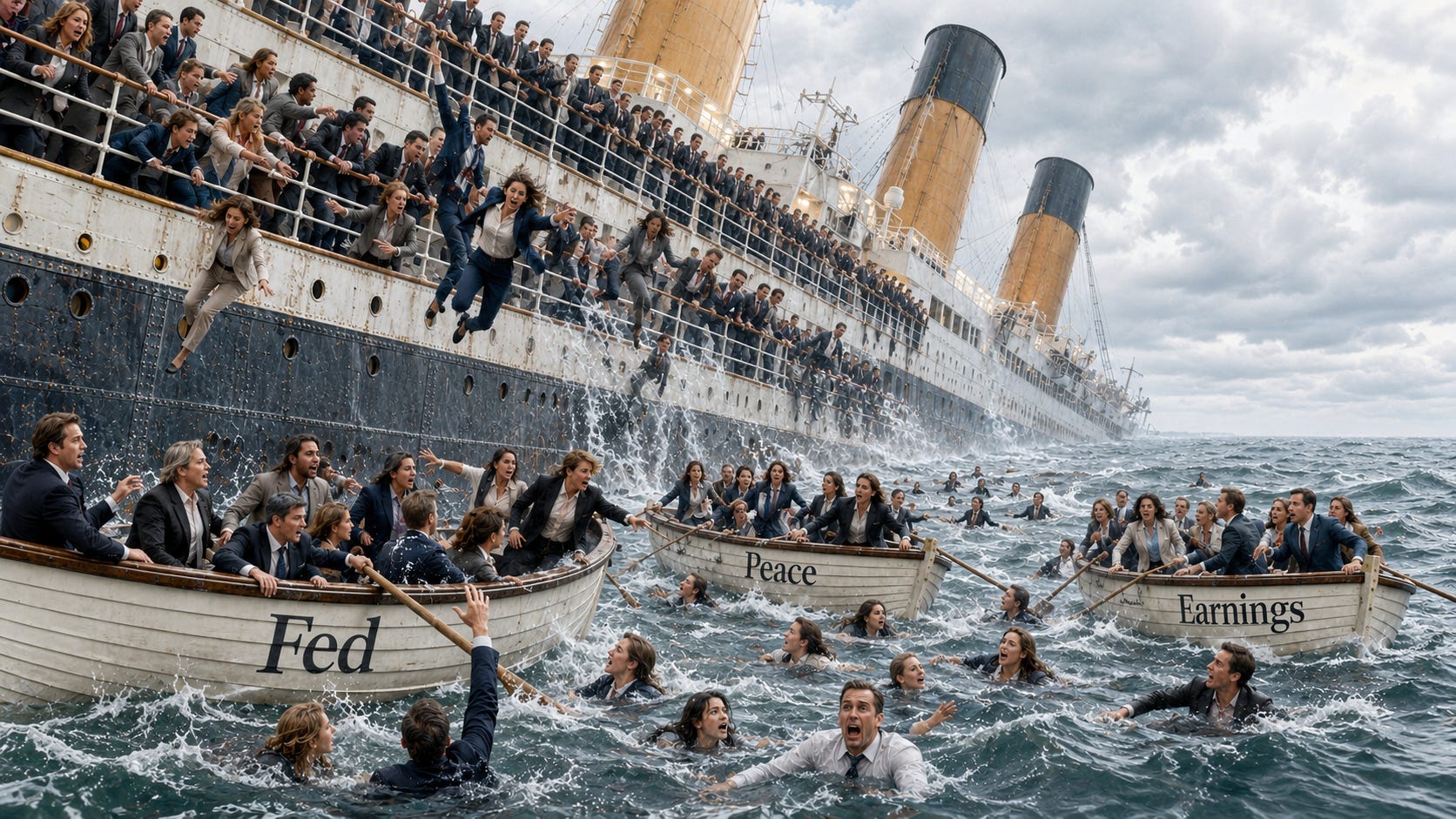
The ship is sinking. The passengers are looking for a lifeboat. But which one has the fewer holes?
Peace in the Middle East? Fed intervention? Some yet unforeseen source of surging profits?
The missiles and drones are again silently waiting. But far too much damage has already been done. And any peace will be provisional. Though rumoured for some time, Russia is helping its ally. Perhaps China might also be a playing yet unseen role.
Warsh impressed the great and good of central banking in Europe, but his American colleagues keep on playing the same old tune, making speeches, hinting at “forward guidance.” Maybe he will take a stronger hand at this week’s FOMC meeting, given the power of his Congressional appearances.
CEO’s and CFO’s might be rewriting their scripts after last week’s Alphabet experience, or perhaps even changing the numbers.
Without a peace deal, Fed action, or some as yet unidentified “new story” to provide support to equity markets, the greedy and the gullible might simply need to put on a lifejacket, to avoid drowning, while hoping for a rescue. In other words, staying afloat, by taking some profits.
The potential problem with this strategy is the gigantic shiver of sharks gathering in the East. America has become China’s “bait ball.” In the tradition of Sun Tzu’s “Art of War,” Xi’s is letting Trump make one imbecilic mistake after another. His simple one-liner to all those fawning American billionaires - that the “Strait must be opened” - has somehow been forgotten in the translation. The missile count has clearly swung in China’s advantage.
“Moonshot” was a more apt name for upending American AI dominance than “Deep Seek.” More consistent with a “Sputnik Moment.”
Championing free trade and the rule of diplomacy, amid the insanity and lies of the Trump Administration, is turning the once hesitant and cautious engagement of the West, into a choice of the lesser evil. Unpredictable and fascist America. Or cooperative and communist China.
Meanwhile, back in the USA, the hollowed-out military and intelligence agencies now speak only “Trump,” who keeps telling us Iran is “toast,” while resurrecting his trade war by different means. The President-in-Waiting has gone icily silent, no doubt hoping the mid-terms are cancelled due to the home-grown communist menace, so he and the congressional allies he has been courting go all-in on the 25th Amendment. His recent book about his journey to become a Christian, brings backs memories of Obama’s “Audacity of Hope.” And unlike Trump’s “The Art of the Deal,” Vance actually has the ability to write it himself.
Wall Street keeps telling us, none of this really matters. It is all just politics. And more to the point, geo-politics. America is an island, self-sufficient in everything that matters. The Street has never had it so good.
The CME has boldly just announced it will be offering single-stock futures contracts on fifty of most popular names with retail investors. Stick that up your leveraged ETFs, BlackRock and Vanguard.
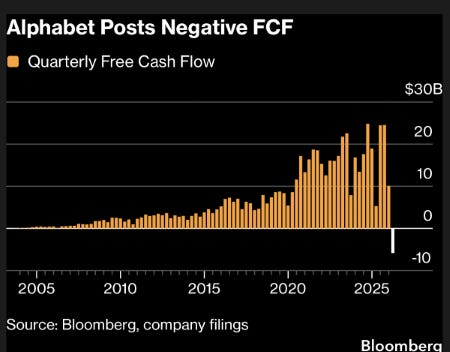
One quarter of negative cash-flow does not make Alphabet a losing bet, despite how dramatic this chart looks. But it might be some time before the next stock buyback.
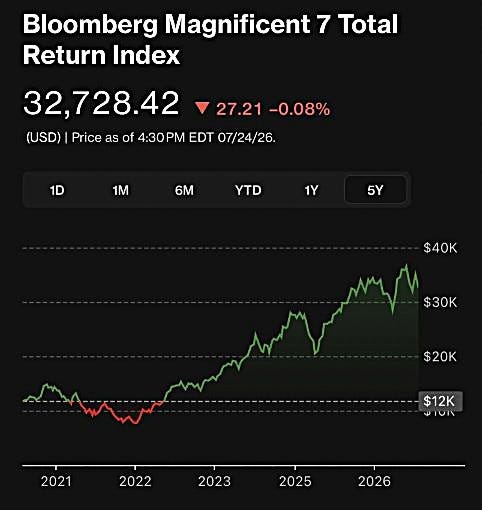
The Magnificent Seven are also not yet dead, with a total return of minus 4 percent so far in 2026, compared 14 per cent over the past year, and a 300 percent return on investment from the low in early 2022. Surely something similar can be repeated.
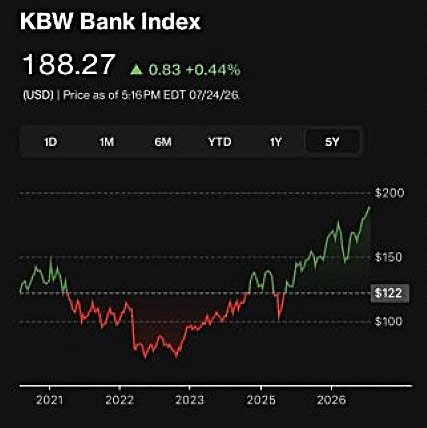
As for the banks, the total return this year has been almost 15 per cent, and 33 per cent over the past year. A truly astonishing result, thanks to the TACO man, Reddit, You Tube, and all those other social media guru’s.
As mentioned last week in “The End of the Beginning”, the current low level of individual stock correlations is unquestionably the result of the huge volumes of individual stock trades, rather than trading in indices. Hence the CME’s announcement mentioned earlier
Despite all the dire headlines last week, the huge “ocean liner” of a bull market has simply taken on a little bit of water. The hole in the hull is not that big. It will need to get much bigger before the ship’s final plunge to the bottom of the ocean. Some technical analysts are suggesting that the major indices are displaying a “rounded top,” an early signal of bad things to come. Others are looking at the trendline support levels. From the 2021 lows in the S&P 500 until now, the ship could sink to the low five thousand level, a 30-40 percent plunge from where it is now, depending on the analyst and the methodologies used.
What could negate this tragic loss of paper wealth?
Well, the most obvious thing would be a sudden surge in profits from AI. But is that reality feasible for entire sector, given the intensity of competition. Is it not simply too early for earnings to come close to fulfilling the promise inherent in current valuations. As I have argued many times over, the AI revolution will unquestionably change the world. But there will be a mere handful of winners, and hundreds, perhaps thousands, of losers.
So, if the ship sinks, the lifeboats prove inadequate, and the sharks eat the “bait ball” of those floating in their life jackets, how might events unfold?
Well, as discussed in the “Beware the Trump Put,” direct intervention in US equity markets is a higher probability than many might think. It is already happening on a small scale, and Trump could easily do “whatever it takes,” to support the market. It is not as if there are no precedents. China, Japan, and other countries have intervened in equity markets, just as they have done in bond and currency markets.
Warsh wants to fundamentally change the Fed, but in a market crisis, the Fed will still intervene. It is the permanence of liquidity support, and the bailing out of the insolvent, not just the illiquid, where his actions might differ to his predecessors. But such an approach is about the aftermath, not the sinking itself.
The Fed has expanded currency swap limits with the major central banks to avoid the dollar shortages from unwind the of dollar carry trades that led to the severity of 2007-2009 global financial crisis. The current weakness of the Yen is the most visible sign that carry trades still play a major role in global leverage. A yen rally could be the first sign of panic. But so could a surge in the dollar.
Slashing the Fed funds rate, as happened in 2020, cannot therefore be ruled out. It would be a boon for the US Treasury market.
But with inflation still above target in most countries, and the increasing acknowledgement that the zero-rate era simply encouraged an unwelcome degree of risk taking, worsened inequality, leading to both political and societal division, I suspect there will be much greater institutional reluctance. Assuming, of course, that the United States still resembles a democracy, rather than a dictatorship.
Good luck.